
Block Party
"I am responsible for the unsticking"
You’re peeking in on the email correspondence between Jade Chang and Ann Friedman, two best-selling authors (and friends!) who host workshops for writers. We spend so much time in conversation about the creative process that we thought we’d share some snippets with you. This newsletter is copy-pasted, unfiltered, and 100% free.
If you, too, enjoy overthinking the writing life, please subscribe. To join the conversation in real time, sign up for our next workshop, UNSTUCK, especially for writers who are, well, STUCK, with a project they can’t quit and can’t complete. It features extraordinary Guest Writer Jami Attenberg, and starts on April 26th. We’d love to have you! (A special discount code below for our Substack subscribers.)
In this edition: The yips, writer’s block, painter’s block?, composer’s block?, genii —> genius, and some gentle domming.
---------- Forwarded message ---------
From: Jade Chang
Subject: getting honest about stuckness
To: Ann Friedman
You know how we both just kind of wholesale reject the idea of writer's block? In fact, I feel like that might have been one of our first bonding moments as WRITERS— which, how rude of us! (Omg I did not put writers in all caps- that was some AI editorializing!) I was thinking about that for two reasons-
One: why is *being stuck* different from *writer's block*? Is it that the concept of stuckness also implies unstuckness? In other words, that stuckness feels more like a temporary state whereas writer’s block is ongoing?
Two: Did you know that I love articles about pitchers getting the yips? (This might be the first one I read.) In part because I enjoy learning about highly specific diseases—I also think Paris syndrome is fascinating—but really the yips are just a version of writer's block.
Is this actually some toxic stew of fear and fascination and rejection, all simmered together?
---------- Forwarded message ---------
From: Ann Friedman
Subject: Re: getting honest about stuckness
To: Jade Chang
I love that you're calling us out for agreeing that a common writerly experience isn't real and then... creating a whole body of work around addressing that experience. We are truly the worst. At least you are holding us accountable!
I suppose that for me, yes, stuckness is quite different from how "writer's block" tends to be invoked. Writer's block is talked about as a persistent condition, one that lasts for weeks or months or even years. For me, it is associated with the idea of the artist as a lone genius who is supposed to be able to sit down in front of a blank page and unspool a brilliant narrative in a linear way. "Block" is not being able to enact this fantasy version of the writing life where words are always flowing.
Stuckness is rooted in reality. Every writer gets stuck—those moments when you doubt the value of a piece of writing and wonder whether or how to move forward. Whereas writer's block comes with a fatalistic feeling that all you can do is sit idly and wait for inspiration to barrel into you, "stuck" is about a failure to commit or to keep pushing through obstacles. I usually get stuck when I fall out of my writing practice. I may not have gotten myself stuck, but I am responsible for the unsticking. I'm in control.
Mostly I hate that writer's block frames writing as special. Why don't we hear about painter's block, or composer's block? Writers haven't cornered the market on creative frustration! Every artist is just out here trying to find ways to massage their doubts and keep making their work, even as the mundane details of life threaten to crowd it out.
---------- Forwarded message ---------
From: Jade Chang
Subject: Re: getting honest about stuckness
To: Ann Friedman
I think you're right in the analysis of how stuckness being a temporary makes it more palatable—writer's block feels a little bit like saying “Macbeth” in a theater. I don't actually believe in it, but I don't want to risk invoking it, either.
But I don't know, I do think all kinds of artists get stuck creatively—including (maybe even especially) painters and composers. They just don't have a cute term for it because... they're not writers! Haha!
It's interesting to think about it in terms of the artist as tortured genius. My feelings about that change all the time. Depending on what stage of work I'm at, or maybe even what stage of life I'm at (what stage of the ever-changing hormonal cycle I'm at?) there are certain things I read or hear that do feel touched by genius to me. BUT…maybe it’s just things I can’t personally do?
It’s so weird that tortured genius is one of the lenses by which we collectively see the world. I know not everyone buys into it, and of course we are both sort of rejecting it, but we can’t reject the fact that it exists as an organizing principle. You know what? And maybe this is what keeps me from full-on genius—I rarely feel emotionally tortured by anything I write, even if it’s deeply vulnerable. But sometimes, when it's the middle of the night and I'm still trying to figure something out and I know that if I just keep on sitting there until the literal bones in my ass start to hurt, something will come—that does feel low-key torturous.
Do you feel like you reject the concept of genius entirely? As you probably know, I think I like it in a romantic sense but I'm also suspicious of it.
---------- Forwarded message ---------
From: Ann Friedman
Subject: Re: getting honest about stuckness
To: Jade Chang
That's a fair point: Writers are simply good at naming feelings, so of course we claim our stuckness with a special label. Ok, let's go with that!
Maybe I'm just being petty because I can't imagine ever identifying as a genius myself, not even in a fleeting moment. I do not reject the idea altogether. I believe in unique brain chemistry and some degree of raw talent and personal inclination, and I believe in luck and circumstance. But mostly I believe in hard work and dogged pursuit of artistic vision. If genius is the word we're using to describe an artist who has some combination of those things, with a healthy helping of boundary-pushing, fine! But I think people tend to mean it in more of a cosmic-fate kind of way, like some individuals are born to make great art. Even Bjork puts her swan dress on one leg at a time. Even Kurosawa directed some duds.
By the literal definition, though, I believe tons of people are geniuses. Including maybe me and you?!
Another thought: Maybe I'm not petty, maybe I just have to reject the loftiest definition of genius in order to get anything done at all!
---------- Forwarded message ---------
From: Jade Chang
Subject: Re: getting honest about stuckness
To: Ann Friedman
This is literally the first time in my entire life that being sent the dictionary definition of something (how many movie voiceovers start with, “Webster’s dictionary defines…”) actually changed my understanding! I love the first usage, though they might have to change that third example:
1a plural genii : an attendant spirit of a person or place
b plural usually genii : a person who influences another for good or bad
He has been accused of being his brother's evil genius.
2: a strong leaning or inclination : penchant
3a: a peculiar, distinctive, or identifying character or spirit
the genius of our democratic government
b: the associations and traditions of a place
c: a personification or embodiment especially of a quality or condition
4 plural usually genii : spirit, jinni
You know what? What if you think of it as being a writer who searches for the genius of a piece? I feel like that is our actual goal, always!
A TEMPORARY INTERRUPTION IN FORMAT!
That particular email back-and-forth ended with us switching to text and talking about how explicit we should make this search for genius during our next multi-week online workshop.
Now, this is kind of weird, but… maybe you want to look at some ads for that workshop?
Ok, no one wants to look at ads. But hear us out. You’re on this list because you’re interested in our discussions about writing and in our Ideas Workshops, so perhaps you’d enjoy a behind-the-scenes peek at how we develop a joint idea.
Some context: We’ve been jointly teaching workshops since 2017, and we’ve never advertised before. Up until now we've mostly relied on Ann's newsletter, our personal social media, and word of mouth. But with these online workshops, it’s time to pursue a more far-flung audience. Which means ADVERTISING.
We put on our best Mad Men suits (quite literally, as you’ll see in a moment) and started scheming. We knew we didn't want to just use a soft-focus shot of a writing desk and a steaming cup of coffee. Well, we wondered, what is it that writers looking to jump-start a project really want?
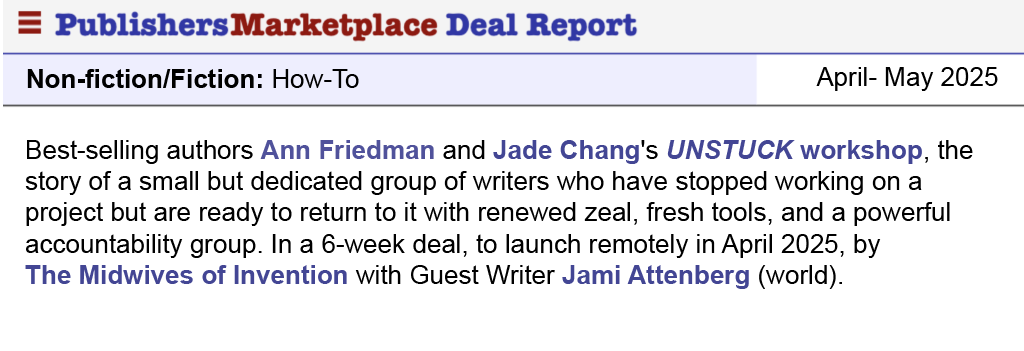
Without even a second of hesitation, we knew: They want to be done with this thing already. And what better symbol of writerly done-ness than a Publisher's Weekly book announcement?!
Then we both made this face 😬😬😬 [grimacing emoji x3] as we mentally played out how deeply confrontational that might be in an ad. And then, dear reader, we made that ad. Twice.
Announcement A:
Announcement B:
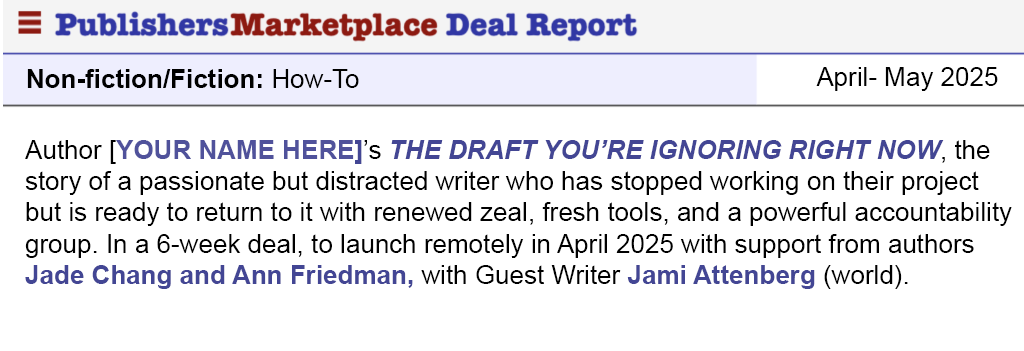
Now picture it was a caption, something along of the lines of: “YOU CAN’T HAVE ONE OF THESE UNTIL YOU FINISH YOUR BOOK.”
Horrifying, in a delicious sort of way, right?
Okay, here’s the problem. Once we started thinking of ads, it was hard to stop. Especially when a friend took a photo of us in our suits, projecting a saucy, just-finished-a-draft energy. And…look, maybe you’d rather be lexically dommed by an earth sign and a water sign?
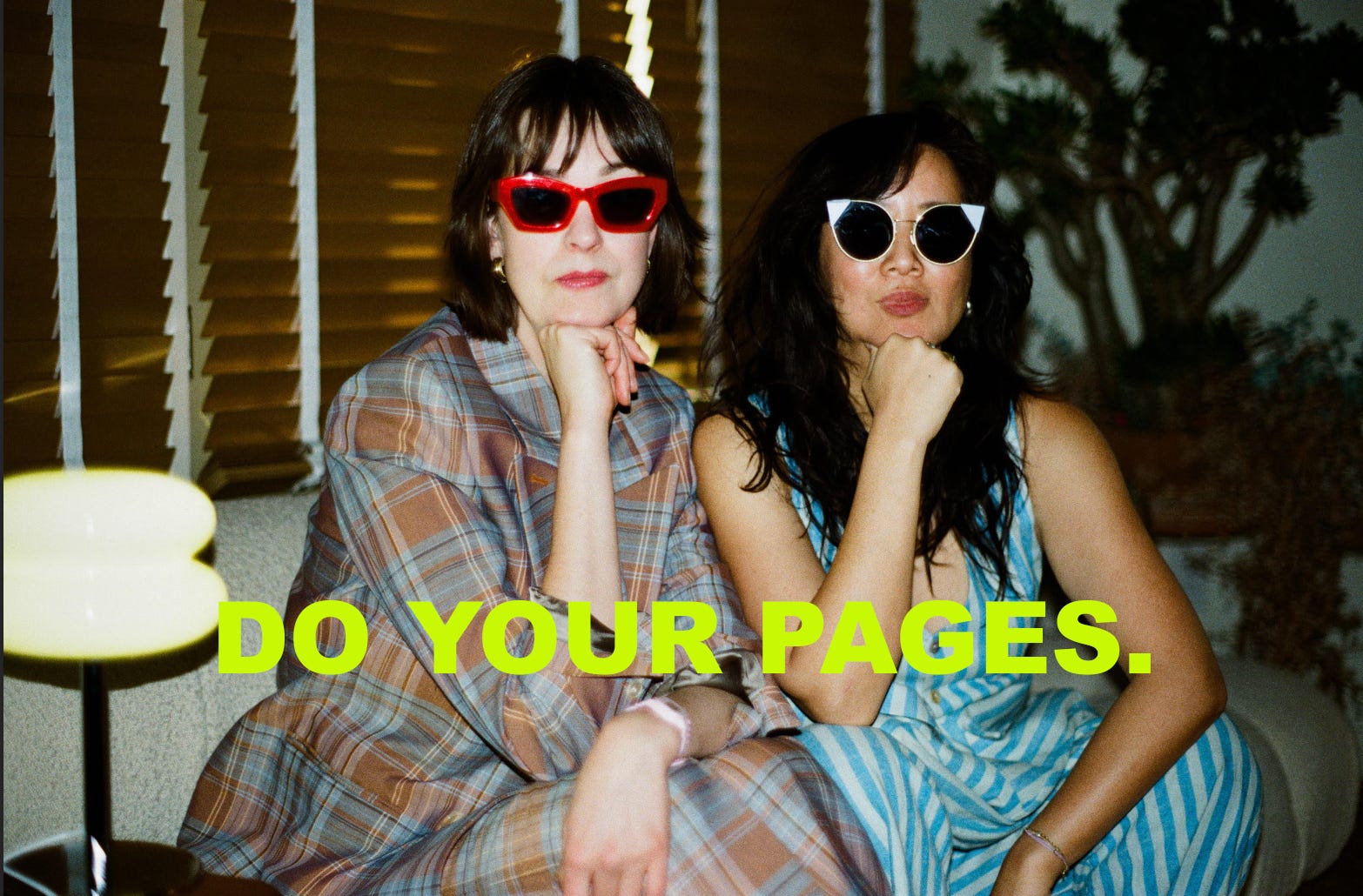
Which of the three do you like the most? Please let us know!
Thank you! We’ll let you know which ad won! (And if you want to snag a spot in the UNSTUCK Workshop before this goes wide, use the code BTS2025 for $75 off!)
This has been a sneaky peek into the correspondence between Jade Chang and Ann Friedman, aka the Midwives of Invention. We’ll forward another one soon.
If you, too, enjoy overthinking the writing life, please subscribe. To join the conversation in real time, check out our upcoming workshops. We’d love to have you!
